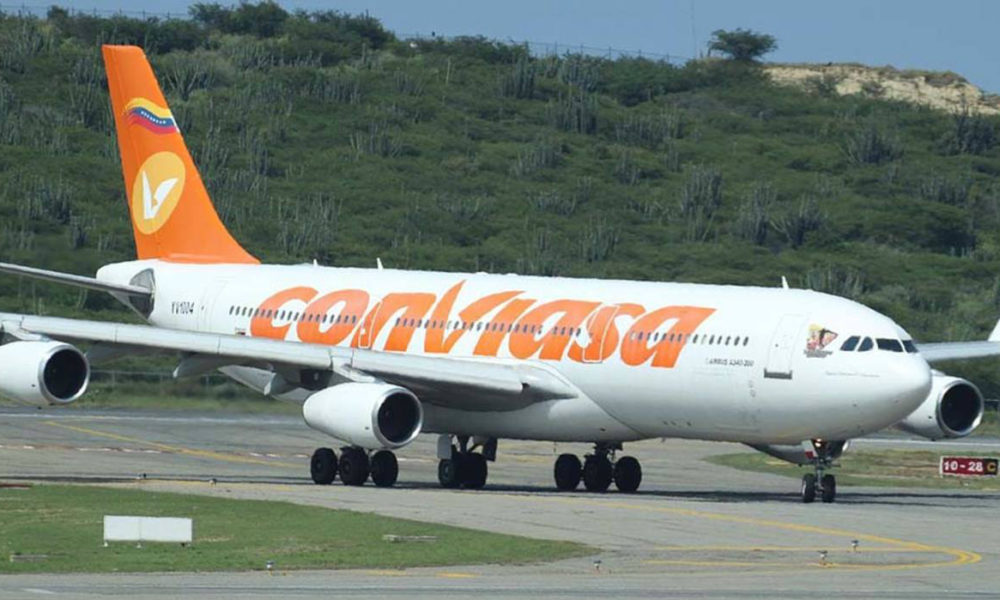
While the United States continues to warn airlines against serving as channels for migrant trafficking via Managua, the Venezuelan airline Conviasa will add two new flight frequencies to Nicaragua this week. These flights will have a layover in Havana and depart from Caracas.
On its account X (formerly Twitter), Conviasa is promoting its new direct flight frequency to and from Managua departing from Caracas, with a connection in Havana. «DidYouKnow || #Managua is home to important historical sites such as the Plaza de la Revolución, the Palacio de la Cultura, and the National Museum,» the airline promotes its new frequency.
Although the advertising targets flights for tourism purposes, the reality is that Venezuelans have been experiencing a deep economic crisis for over a decade, leading them to leave the country primarily in search of better opportunities in the United States and other countries. Until a few year ago, the most popular route was by land, passing through the perilous Darien Gap in Panama, where hundreds have lost their lives.
In the case of Cuba, the situation is similar. Hundreds of thousands of Cubans have used Nicaragua since 2022 to reach the United States, after the regime of Daniel Ortega eliminated the visa requirement for them. This facilitated their entry into the country, which serves as a springboard and has contributed to the humanitarian crisis at the border between the United States and Mexico.
Conviasa is adding frequencies
Until now, Conviasa had flights from Havana to Managua on Mondays, Wednesdays, Thursdays, and Saturdays. Now, Conviasa will add connections with flights departing from Caracas, where Venezuelans and Cubans will embark towards Managua.
«The company, created in 2004 by then-President Hugo Chávez, will significantly increase its revenue with these new flights. On one hand, it responds to the demand for flights to Caracas, a destination popularized by ‘mules’ [individuals who transport goods illegally] and where costs have risen. On the other hand, it continues to exploit the Managua route, the escape route for thousands of Cuban migrants intending to reach the US,» according to the digital Cuban independent newspaper 14ymedio.
In fact, the connection from Caracas comes at a time when the United States is trying to curb the use of international airlines to bring migrants to the country via Nicaragua. However, the initial official numbers from the regime suggest that there is little effectiveness in this regard.
Are U.S. efforts failing?
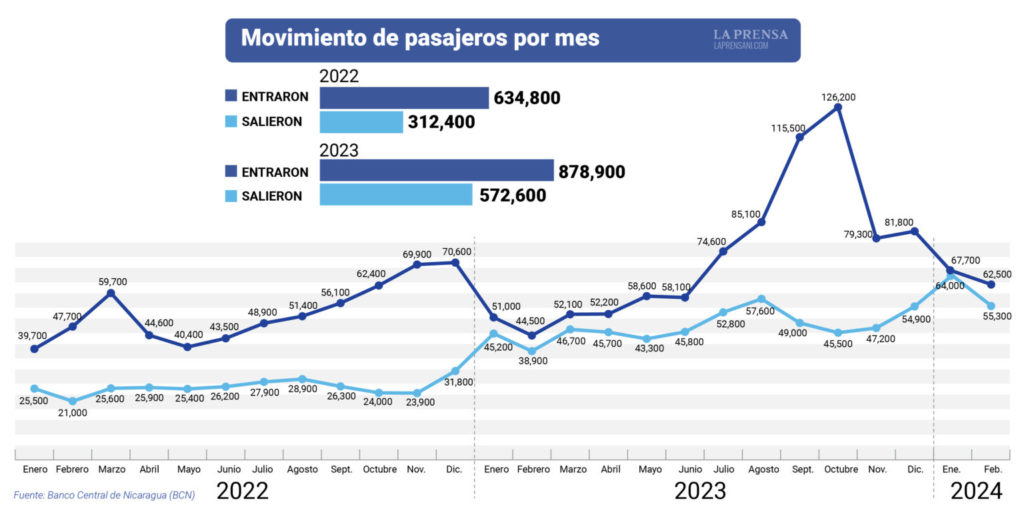
Between January and February of this year, according to recently updated figures from the Central Bank of Nicaragua (BCN), 130,300 passengers arrived at the Augusto C. Sandino International Airport, of which only 119,300 returned to use the same route to leave Nicaragua. This means that in only two months there is a differential of 11,000 who would have been immigrants who chose to continue their route to the United States by land.
The differential is almost the same as last year during the same period. In the first two months of 2023, 95,000 passengers entered through the Managua airport, but only 84,100 departed. This indicates a differential of 10,900 travelers.
However, the variation in 2024 is considerably smaller than in 2022 when Ortega’s strategy of placing migrants on the borders of the United States was taking shape. In the first two months of that year, 87,400 arrived, but only 46,500 departed through that route, resulting in a differential of 40,900.
Will the strategy be maintained in 2024?
If the pace exhibited by the 2024 figures remains consistent with that of 2023, there will be a significant influx of migrants through Nicaragua to the United States by the end of this year. For example, in 2023, 878,900 passengers entered through the Managua airport, but only 572,600 departed. This indicates a differential of 306,300 people who likely continued their journey by land to the United States.
However, the record was set in 2022 when this strategy was launched. That year, 634,800 people entered through the Managua airport, but only 312,400 departed via the same route. This means that a large portion of the 322,400 people who stayed in the country continued their journey by land to the United States.
Following this massive mobilization of irregular migrants in 2022, facilitated by hundreds of charter flights arriving in Managua daily, first from Cuba, then from Haiti and other Caribbean islands, the United States imposed the first sanctions on airlines offering this service in November 2023. At that time, flights from these islands decreased, but those from Europe, Asia, and Africa increased, as the business had expanded globally.
The Caracas connection will benefit Ecuadorians
Conviasa’s connection will occur at a time when the statistical yearbook of the Nicaraguan Institute of Tourism (Intur) revealed that not only Cubans and Haitians are using the Managua airport to reach the United States, but also Ecuadorians fleeing a situation of violence in their country caused by drug trafficking organizations.
According to the Intur report, in 2017, 2,215 Ecuadorians arrived, but in 2022, 44,221 Ecuadorians entered the country, representing a 1,900 percent increase. Of the total, only 261 entered the country by land, while 43,960 arrived by air. Therefore, Ecuadorians represent 9 percent of the 485,277 travelers received by the airport in 2022, according to Intur. In their case, they were not tourists but migrants in transit to the US border. In total, Cuban migrants along with Ecuadorians represent 67 percent of the visitors received by the Augusto C. Sandino International Airport in 2022.
Sanctions have not stopped Conviasa
The US Department of State announced on February 21 an extension of measures initially aimed at curbing charter flights with migrants to Nicaragua, now targeting executives, owners, and high-ranking officials of transportation companies involved in facilitating «irregular» migration.
Meanwhile, the statistics of passenger arrivals and departures at the Managua airport reflect that these sanctions have been ineffective. On the other hand, the Ortega Murillo regime continues to profit from this business. According to the 2023 Budget Settlement Report, fees associated with the transit of people generated 1,905 million córdobas (approximately 52 million dollars at the official exchange rate), exceeding 2022 revenues by 62 percent.