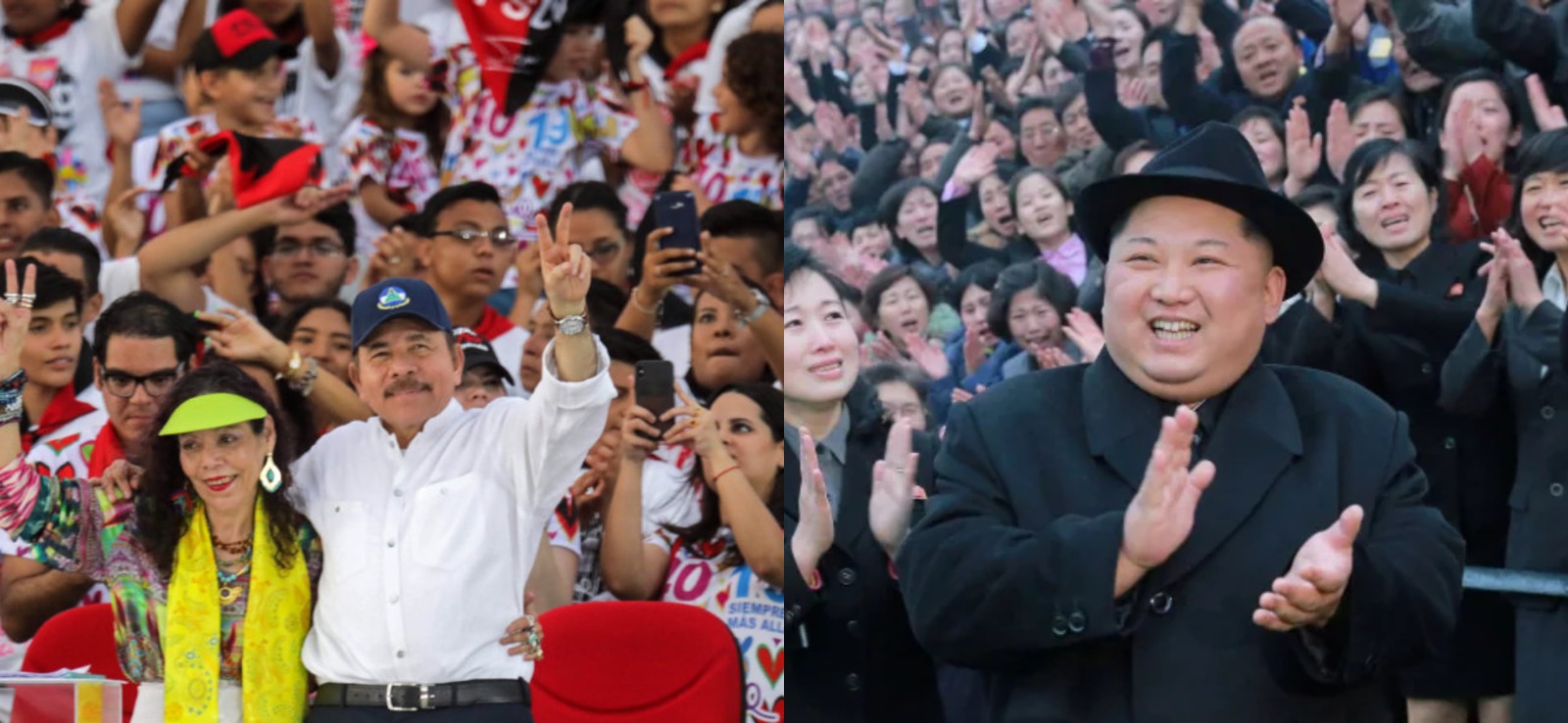
The regime of Daniel Ortega appointed Manuel Modesto Munguía Martínez on Friday as ambassador to North Korea, one of the most secretive and problematic countries in the world, governed by another totalitarian dictatorship.
Last October, Rosario Murillo announced the regime had received the agreement of Kim Jong-un to open an embassy in Pyongyang, the capital of North Korea. Two days ago (December 28), she reported that Munguía had been accepted by the dictatorship of that country as an ambassador.
«We have received the approval for the establishment of our Nicaraguan embassy in Pyongyang, North Korea, and our ambassador, who will be heading there as a resident ambassador in the coming weeks,» she said last October.
Nicaragua joins the small number of Latin American countries with an ambassador and embassy in North Korea, where Kim Jong-un rules that nation with an iron fist, amidst poverty, scarcity, and strong isolation from the world. Besides Cuba and Venezuela in Latin America, in recent years Ortega has strengthen diplomatic, political and in some cases military relations with China, Rusia, Iran, Bielorrusia and now North Korea, all of them totalitarian regimes.
Since 2018, he Ortega regime has adopted a behavior quite similar to the North Korean regime, leading Nicaragua to be seen in Central America as the North Korea of the region.
Both regimes govern in a strikingly similar manner. Among the similarities are the cult of personality, a single party, sham elections without free media, erratic and confrontational diplomacy with the democratic world, as well as policies of forceful exile or jail for opposition leaders, among others.
Also read: «The Troubling Similarities Between Nicaragua and North Korea.» (in Spanish)
The appointment of Munguía Martínez, a low-profile former councilor of Managua within Ortega’s dictatorship, appeared this Friday in La Gaceta, through presidential agreement 251-2023.
It’s still unclear how much the Nicaraguan taxpayers will bear for the opening of an embassy in a country where there are zero opportunities for trade or cooperation.
Corea is preparing for war
The official appointment of Ortega’s envoy to North Korea comes a day after Kim Jong-un urged his party to «accelerate» preparations for war, including their nuclear program, as reported by the state press last Thursday.
Kim comments came a week after he warned that his country wouldn’t hesitate to launch a nuclear attack if «provoked» with atomic weapons. Kim addressed the issue during the meeting of the ruling Workers’ Party of Korea, where he is expected to announce political decisions for 2024.
He urged his party to «further accelerate war preparations» in various sectors, including nuclear weapons and civil defense, as reported by the official news agency KCNA. He asserted that the «military situation» on the Korean Peninsula has become «extreme» due to «unprecedented» confrontations from Washington.
South Korea, Japan, and the United States have intensified military cooperation amid this year’s surge in North Korean weapons tests. They have activated a system to share real-time information about North Korean missile launches.
Weeks ago, a nuclear-powered U.S. submarine arrived at the South Korean port of Busan, and Washington sent long-range bombers to conduct exercises with Seoul and Tokyo.
For Pyongyang, the deployment of strategic weapons like B-52 bombers in joint maneuvers on the Korean Peninsula represents «intentionally provocative actions by the United States toward a nuclear war.»
This year, the North launched a reconnaissance satellite, enshrined its status as a nuclear power in its constitution, and tested the most powerful intercontinental ballistic missile (ICBM) in its arsenal. Kim defined 2023 as a «year of great change» in which his country achieved «revealing victories.»
Nuclear confrontation
Last week, the International Atomic Energy Agency (IAEA) stated that a second reactor at the North Korean nuclear facility in Yongbyon appeared to be operational, labeling it as «deeply regrettable.»
Next year, North Korea could «deploy tactical nuclear weapons to areas near the border» with the South and escalate its nuclear program, as anticipated by Ahn Chan-il, a defector turned researcher who heads the World Institute for North Korean Studies, speaking to AFP. Pyongyang might take such actions to exert «strong pressure» on South Korea and the United States while maintaining close relations with its traditional allies Russia and China, he added.
In the party meeting at the end of last year, Kim called for «an exponential increase in the country’s nuclear arsenals.»
Weeks ago in Washington, the United States and South Korea held the second meeting of their Nuclear Consultative Group, discussing nuclear deterrence options in the event of a conflict with the North They warned that any attack by Pyongyang against the United States or South Korea would result in the end of Kim’s regime.
A spokesperson from the North Korean Ministry of Defense criticized the plans of those countries to expand their joint military exercises, labeling them as «an open declaration of nuclear confrontation.»
Last year, North Korea declared itself an «irreversible» nuclear power and asserts that its nuclear program is crucial for its survival.