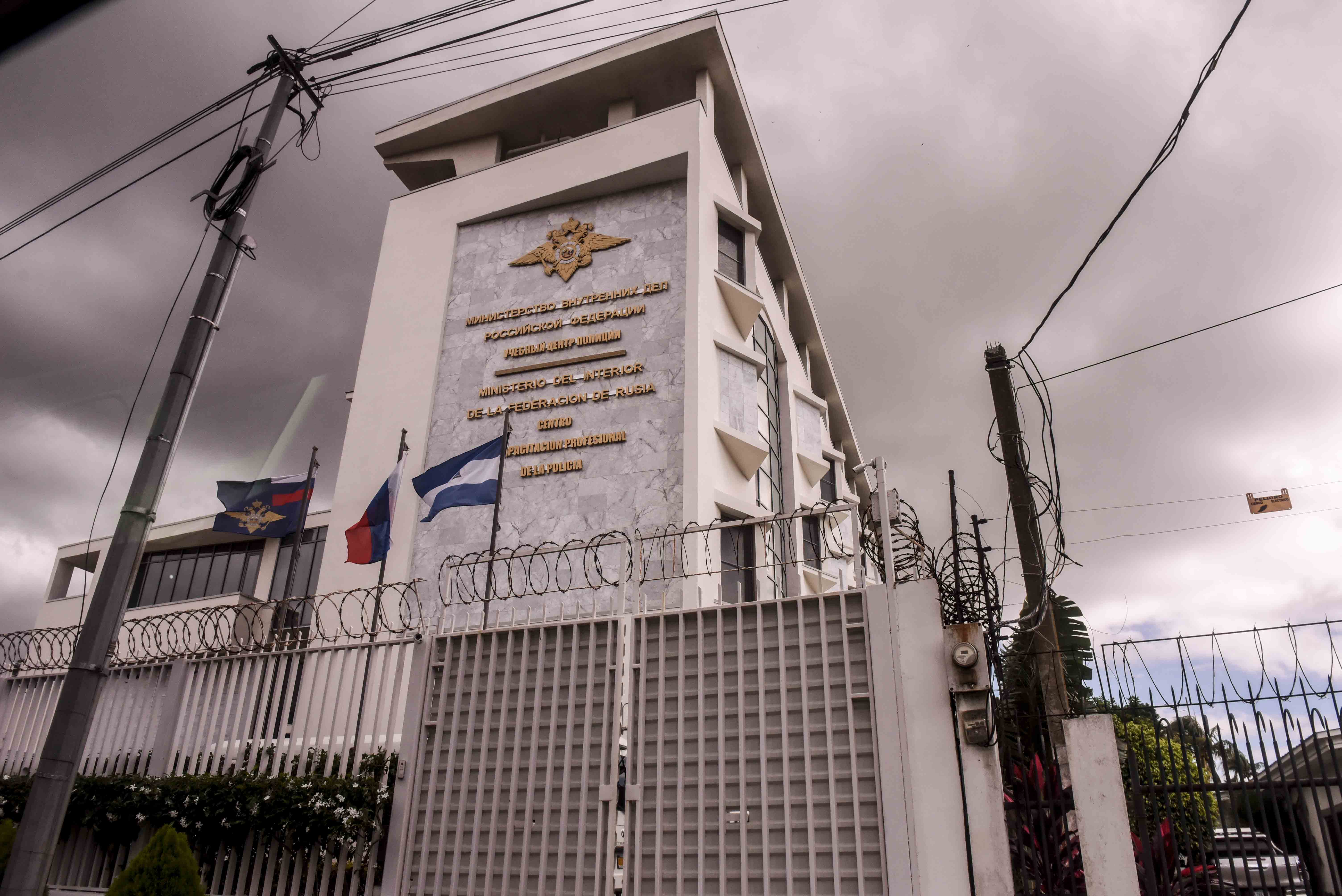
The Embassy of the Russian Federation in Costa Rica responded to remarks made by Foreign Minister Manuel Tovar during the 56th General Assembly of the Organization of American States (OAS) with a statement built around three central claims. It argues that Russian-Nicaraguan cooperation is humanitarian, educational, and training-oriented; it notes that the presence of Russian personnel is based on bilateral agreements and consistent with international law; and it maintains that this cooperation is not directed against any third country.
None of those assertions explains the true scope of the relationship between Moscow and Managua.
Costa Rica’s concerns are not about the legality of agreements between two sovereign states. The real issue is the strategic purpose that this relationship has come to serve and the implications it carries for Central America.
An Alliance Driven by Strategic Interests
States do not sustain military, technological, law enforcement, and diplomatic cooperation for years simply to exchange expertise. Major powers invest resources where they identify strategic interests, and today Nicaragua occupies that place in the Kremlin’s foreign policy.
Even before Russia’s invasion of Ukraine, Moscow had found in Managua a reliable partner for expanding its presence in Latin America. After 2022, that relationship became even more valuable. While much of the international community condemned Russia’s aggression, Daniel Ortega’s regime consistently backed the Kremlin’s positions at the United Nations and other multilateral organizations.
The relationship is based on a mutual exchange of interests. Russia gains an ally that helps reduce its diplomatic isolation while projecting influence into a region that has long been strategically important to the United States. Ortega, meanwhile, secures political backing that softens his own international isolation and strengthens ties with a major power that does not condition its cooperation on respect for democracy, transparency, or human rights.
That essential context for understanding the bilateral relationship is entirely absent from the Embassy’s statement.
Cooperation Goes Far Beyond Humanitarian Assistance
The statement portrays Russia’s presence as a collection of training programs, exchanges of expertise, and humanitarian assistance. Those activities certainly exist, but they do not describe the true breadth of the partnership.
In recent years, ties between Moscow and Managua have expanded into the military, law enforcement, technology, and cybersecurity sectors. They also include strategic infrastructure projects, such as the GLONASS satellite navigation station, as well as permanent mechanisms for cooperation between the security institutions of both governments.
Viewed individually, these initiatives may appear to be technical projects. Taken together, however, they reflect a long-term strategic partnership.
Nicaragua’s domestic situation makes this cooperation even more significant. Since 2018, the regime of Daniel Ortega and Rosario Murillo has imprisoned political opponents, eliminated political competition, shut down independent media outlets, confiscated universities, expelled international organizations, and severely restricted civil liberties. In that environment, strengthening the state’s capabilities also means strengthening institutions that have been used to control and repress society.
The information dimension is another aspect the Embassy’s statement ignores. At Expediente Abierto, we have documented how Russia uses state media, digital platforms, and communications cooperation agreements to promote narratives favorable to the Kremlin, discredit Western democracies, and reinforce politically aligned governments. Nicaragua has become part of that ecosystem by reproducing content from Russian state media and through the increasingly aligned messaging of both governments.
This is not merely a matter of propaganda. It is about consolidating a political model in which the concentration of power and the weakening of institutional checks and balances are presented as legitimate forms of governance.
A Legitimate Concern for the Region
The Russian Embassy argues that its relationship with Nicaragua is not directed against third countries. Yet competition among major powers is no longer expressed solely through military bases or troop deployments. It increasingly unfolds through political influence, technological cooperation, intelligence, cybersecurity, critical infrastructure, strategic communications, and diplomatic alliances.
Those are precisely the areas in which cooperation between Moscow and Managua has deepened.
Research on Russia’s strategy in Central America shows that one of the Kremlin’s primary objectives is to consolidate politically aligned governments, expand the reach of anti-Western narratives, and preserve spheres of influence beyond Eurasia. Nicaragua plays a central role in that strategy. At the same time, the Ortega regime uses the alliance to reduce its international isolation, secure diplomatic support, and reinforce an authoritarian model that enjoys diminishing legitimacy among the world’s democracies.
For that reason, the concerns raised by Costa Rica during the OAS General Assembly do not represent an overreaction. They reflect a strategic assessment of a reality that extends well beyond diplomatic statements.
The Russian Embassy itself calls for the debate to be grounded in verifiable facts. Those very facts demonstrate that the relationship between Moscow and Managua extends far beyond humanitarian cooperation. Russia has turned Nicaragua into its principal platform for projecting political influence in Central America, while Daniel Ortega’s regime has found in the Kremlin an indispensable partner for sustaining its authoritarian project. That strategic dimension is precisely what the Embassy chose to leave out—and why Russia’s growing presence in Nicaragua is generating increasing concern across the region.
The author is the founder and executive director of Expediente Abierto, a Central America-focused research center specializing in strategic affairs, security, international relations, and defense.