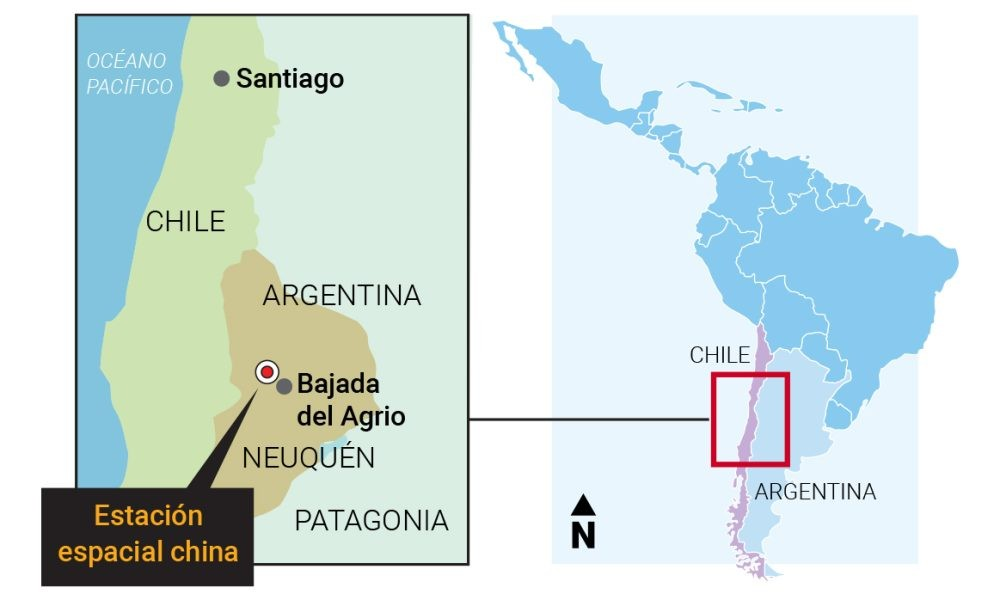
Officially, the Deep Space Station operated by China in Argentina is primarily intended to “support activities such as interplanetary exploration, astronomical observation, and satellite tracking and control in orbit.” However, the facility raises concerns both domestically and regarding security in the United States.
At a cost of approximately $50 million, it was built by the Chinese firm China Harbour Engineering Company Ltd. between 2014 and 2017 near the town of Bajada del Agrio, in the northwestern province of Neuquén, in a remote desert area. Its legal foundation lies in cooperation agreements signed by Peronist President Cristina Fernández. These agreements followed the notable rapprochement between the two countries during the administration of her late husband, Néstor Kirchner.
The former president established a «strategic partnership» with China, aiming to secure investments, financing, and increased trade.
Additionally, the agreement regarding the base was negotiated in secret when China came to Argentina’s aid after it was shut out of international credit markets due to a $100 billion bond default. By that time, China had already disbursed $10 billion through a swap agreement to help sustain the Argentine peso.
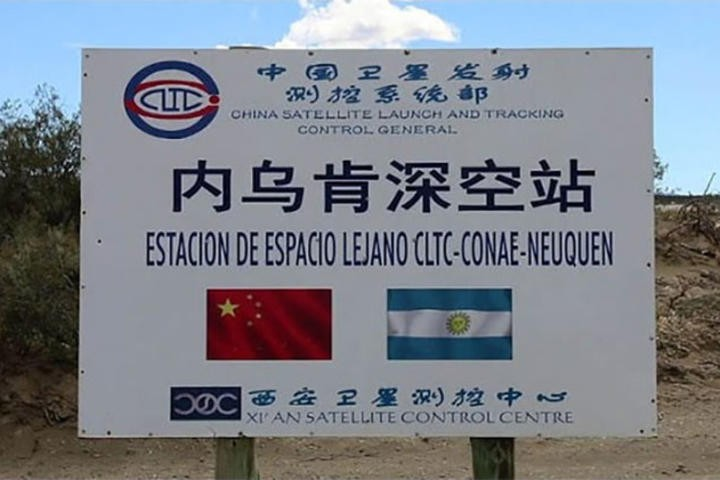
The two agreements that facilitated the construction of the complex were signed in 2012: one between the China Satellite Launch, Tracking, and Control General (CLTC) and the National Commission on Space Activities (CONAE) of Argentina, and the other between the Chinese entity and the province of Neuquén.
A small but significant detail: the China Satellite Launch, Tracking, and Control General (CLTC) is an entity under the control of the People’s Liberation Army (PLA), the Chinese military. It is subordinated to the PLA’s General Armaments Department.
A thick veil of secrecy has shrouded the base’s activities for years, as Argentine authorities cannot enter without Chinese consent, akin to the status of an embassy. In practice, it enjoys extraterritoriality and, according to Argentine media, is “as much Chinese territory as Beijing.” It is the only base of its kind outside of China, with just two other similar facilities, both located within the country. The base is pivotal to the operation of the Asian power’s ambitious space program.
Most controversial aspects
Here are some of the aspects of its existence and operations that have generated the most criticism and controversy in Argentina:
– The Chinese enclave covers approximately 200 hectares and was leased for 50 years (until 2067). The agency operating it is exempt from paying VAT, customs duties, and internal taxes, among others, for the duration of the concession. This includes the acquisition and contracting of Argentine goods, works, and services.
– Chinese personnel are not subject to Argentine legal jurisdiction but instead to the laws of the People’s Republic of China. Their incomes and salaries are determined according to Chinese standards, and they do not pay local income taxes.
– The Chinese side has full control over the activities; Argentine CONAE authorities only have the right to use the facilities 10 percent of the time each year (two hours and forty minutes per day), specifically the antenna, for activities related to the study of distant objects in the universe, such as pulsars and constellations.
«Collectively, these clauses significantly limit Argentina’s sovereign rights and the potential economic benefits associated with a space station operated by a foreign military employing technologies of unknown use,» wrote Australian academic and international relations consultant Erin Watson-Lynn in an article for The Interpreter, an academic website of The Lowy Institute, published in 2020.
«Agreements like this one raise skepticism among critics of the Belt and Road Initiative,» he added.
Former Neuquén provincial legislator Beatriz Kreitman has been a vocal critic of the base since its inception.
«You can get to the fence, but you can’t enter because that’s Chinese territory. In a country where there are access to information laws, we find a base whose activities we don’t know,» she told Newsweek Argentina, which published a report last August that was reproduced by the Infobae portal.
«I think it’s very serious. The transfer of land, the surrender of sovereignty, the fact that not a single tax has been collected, and especially that we are completely unaware of what happens at the base. There are many irregularities,» she added.
Importance of the location for Beijing’s space program
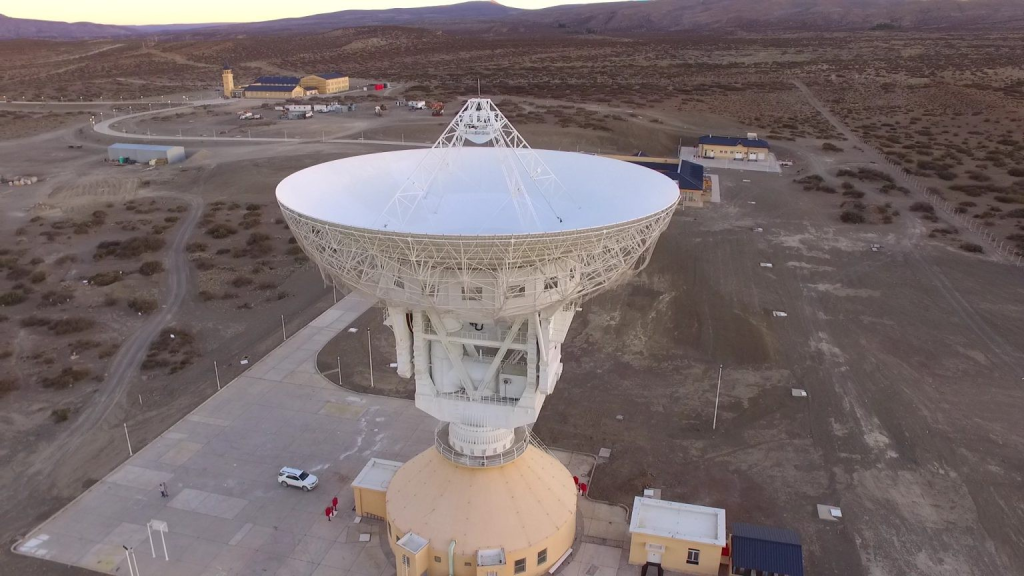
The most important feature of the Chinese base in Neuquén is the massive 35-meter-wide, 48-meter-tall space antenna, weighing about 450 tons. It is the instrument that enables communication with Chinese satellites.
«For China, the satellite base is very important. It is the only one located outside its country and is crucial for its ambitious project to send the first human to the far side of the Moon by 2040. The Station provides support for missions launched by the Chinese Lunar Exploration Program and the Chinese Solar System Exploration Program. Since its installation in Neuquén, it has assisted in tracking a spacecraft that reached Mars, another that landed on the Moon, and a satellite that was placed in orbit as a precursor to the landing on the far side,» explains the report from Newsweek Argentina.
The other two bases of this type in the space program are located in China. For proper tracking of satellites and spacecraft launched into outer space, the system must be deployed at three points on Earth that are relatively opposite to each other.
The base «concerns» the head of U.S. Southern Command
The space station is a facility that clearly demonstrates the potential for dual use, meaning both for civilian and military purposes.
Western security studies assert that the PRC has developed advanced technologies to alter, interfere with, and destroy satellites. This is a dangerous capability in the event of a military conflict.
In addition to its stated purpose, the antenna serves to gather all kinds of information and could easily spy on military or space communications from other states.
«A giant antenna is like a huge vacuum cleaner,» said Dean Cheng to The New York Times in a 2018 article. Cheng, who worked as a researcher in the U.S. Congress, now studies China’s national security policy. «It sucks up signals, information, all sorts of things.»
In 2016, the Argentine government under Mauricio Macri added an amendment to the agreement explicitly prohibiting the use of the station for military purposes. However, U.S. concerns have not ceased.
In a testimony before Congress last March, U.S. Southern Command Chief, General Laura Richardson, explained why the Chinese space base is a source of deep concern.

«Despite its public stance against the militarization of space, the Chinese People’s Liberation Army (PLA) continues to invest in and enhance its military space capabilities, including a deep space station in Argentina, which provides the PLA with global space tracking and surveillance capabilities. These space capabilities could translate into global military capabilities that could support the monitoring, tracking, and targeting of our forces and affect conventional and nuclear targets, land-air-sea operations, precision conventional strike capabilities, and missile defense,» Richardson stated, as quoted by CNN en Español.
During a visit to Argentina in April 2024, the head of U.S. Southern Command addressed why the Chinese space base is a cause for concern. The right-wing, pro-U.S. government of Javier Milei took note and responded by sending an official delegation to inspect the base.
However, the delegation did not observe any military or espionage activities, according to Argentine and international media. In early May 2024, then-Foreign Minister Diana Mondino publicly stated, “They are Chinese; they are all the same,” which sparked controversy and criticism over an allegedly racist tone in her remarks, something she denied.
«They are all the same, those who participated; they are all civilians. We are talking about the visit to the Chinese space station in Neuquén, which took place a few days ago, and I emphasized the civilian nature of the staff, that there were no uniforms. The Argentines were also all the same; none of them were in uniform,» stated the now former foreign minister during a radio interview.
Last November, a journalist from the newspaper La Nación was able to visit the facilities. She had access to work areas and the control room from which the antenna is operated. She wrote that there are seven Chinese scientists, all of whom at the time were from the city of Xi’an, and that the staff is rotated in periods ranging from six months to a year.
In any case, General Richardson’s words during her visit to Argentina regarding the Neuquén base still resonate from Washington: “Obviously, that is a big concern for me as a military officer. And then the capability of what that station does and does for China, against allies and partners.”